Museum / monument Museum
Schwedenspeicher — the Swedish Warehouse museum
This massive brick warehouse, built by the Swedes between 1692 and 1705 as a provisions store for the garrison, is now the most striking building on the Hanseatic harbour. Since 1977 the Schwedenspeicher museum inside has told the thousand-year story of the city and the Elbe–Weser region — with an important archaeological collection and a section on the Hanse. Note: the building is currently undergoing a full refurbishment, so check its status before visiting.
- Address
- Wasser West 39, 21682 Stade
- Phone
- +49 4141 7977340
- Website
- www.museen-stade.de
MuseumHanseSwedish architecture
✏️ Report a correction
Church / monument Gothic
St. Cosmae et Damiani
A 13th-century Gothic hall church with its distinctive octagonal tower above the crossing. The precious baroque furnishings survive — among them the altar by Christian Precht (1674–1677) and the famous organ from the workshop of Berendt Huß and his nephew Arp Schnitger (1668–1675). For 27 years, from 1675 to 1702, Vincent Lübeck was organist here — one of the leading composers of the north German baroque.
- Address
- Cosmaekirchhof, 21682 Stade
- Phone
- +49 4141 2390
GothicSchnitger organVincent Lübeck
✏️ Report a correction
Church / monument Oldest church
St. Wilhadi
The oldest church in Stade — its origins reach back to the 11th century, while the present three-aisled hall dates from the 14th. The 13th-century tower now leans to one side and is fondly called “the leaning tower of Stade”. The interior was completely destroyed in the great fire of 1659 and rebuilt in baroque style. The centrepiece is the organ by Erasmus Bielfeldt (1731–1736) — one of the finest instruments in northern Germany.
- Address
- Wilhadikirchhof, 21682 Stade
Oldest churchLeaning towerBielfeldt
✏️ Report a correction
Monument / day out Harbour
Hansehafen — the old Hanseatic harbour
The heart of the historic town — the harbour basin has been in this spot since about 1300. In its heyday goods were transferred here between Baltic and North Sea ports. Around it stand half-timbered merchants’ houses from the 15th to 17th centuries, the wooden treadwheel crane, the picturesque Wasser West and Wasser Ost quays and the city’s three most famous buildings: the Schwedenspeicher, the Bürgermeister-Hintze-Haus and the Goebenhaus.
- Address
- Wasser West / Wasser Ost, 21682 Stade
HarbourHanseTown centre
✏️ Report a correction
Monument Weser Renaissance
Bürgermeister-Hintze-Haus
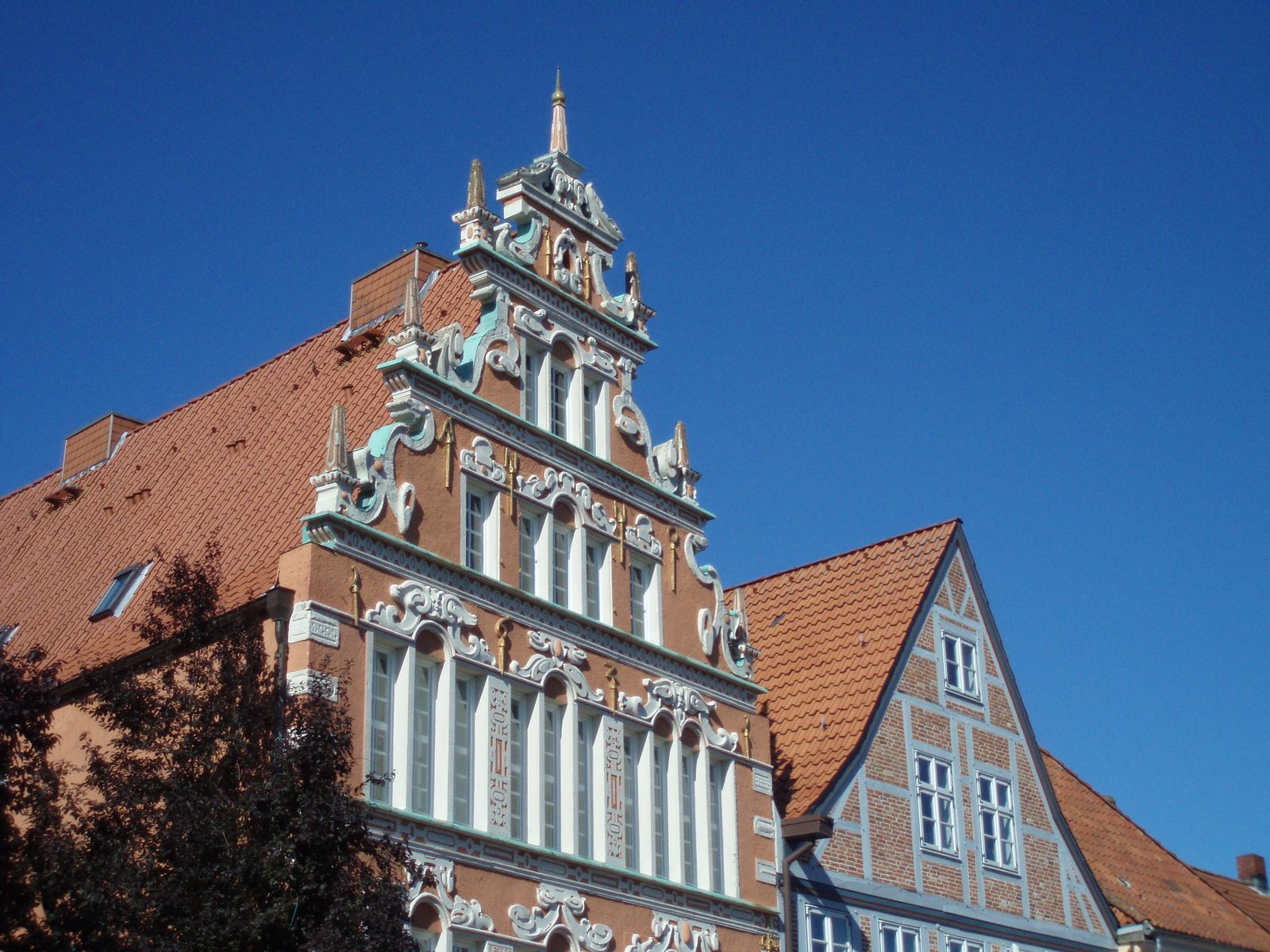
A late-Gothic merchant’s house with a richly decorated façade in the Weser Renaissance style, endowed in 1621 by mayor Heino Hintze. Seven turrets, stone reliefs and its characteristic ornamental gables make it one of the most photographed façades on the harbour. After the severe flood of 1930 the building was dismantled and rebuilt from the original parts in 1932–1933 — though slightly smaller.
- Address
- Wasser West, 21682 Stade
Weser RenaissanceMayor HintzeFaçade
✏️ Report a correction
Monument General von Goeben
Goebenhaus and Goebenkasematten
A plainer but historically charged building right next to the Bürgermeister-Hintze-Haus — the Prussian general August Karl von Goeben was born here in 1816, later a commander in the Franco-Prussian War. The adjoining Goebenkasematten preserve a remnant of the old town fortifications — vaulted brick passages, once defensive, now open to visitors with explanations of the former military works.
- Address
- Wasser West, 21682 Stade
General von GoebenFortificationsCasemates
✏️ Report a correction
Industrial monument Treadwheel crane
Holzkran / Tretkran — the wooden harbour crane
A reconstruction of a medieval harbour crane driven by a treadwheel, put up on the Fischmarkt in 1977. Cranes like this were powered by people walking inside two large wheels — that is how sacks of flour, barrels of herring and bales of cloth were lifted onto the quay. The Stade example follows the surviving crane in Lüneburg.
- Address
- Fischmarkt, 21682 Stade
Treadwheel craneFischmarktMiddle Ages
✏️ Report a correction
Monument Swedish period
Zeughaus am Pferdemarkt — the former arsenal
The arsenal was completed in 1699, during the Swedish period — the monogram of King Charles XII still sits above the doorway. The design came from the workshop of the master builder Andreas Henne. Today the building serves as an events hall, with a restaurant on the ground floor. In 1993 the crypt of the Bremen archbishop Gottfried von Arnsberg, who died in exile in Stade, was discovered in the cellar.
- Address
- Pferdemarkt, 21682 Stade
Swedish periodCharles XIIRestaurant
✏️ Report a correction
Monument Baroque
Altes Rathaus — the old town hall
The early baroque town hall, built in 1667–1668 on the site of a medieval building destroyed in the great fire of 1659. Inside, the richly carved wooden staircase and the ceremonial halls survive. Above the doorway are the Swedish lions and the inscription IUSTITIA ET PIETAS PAX ET CONCORDIA VERNENT — may justice, piety, peace and concord flourish.
- Address
- Hökerstraße 8–10, 21682 Stade
BaroqueTown hallHökerstraße
✏️ Report a correction
Monument Monastery
Johanniskloster — the former St John’s monastery
The three-winged building of the former monastery, erected in 1672–1673 as one of the first reconstructions after the fire. The surviving cloister and courtyard now frame exhibitions, concerts and the city’s cultural events.
- Address
- Johanniskirchhof, 21682 Stade
MonasteryCloisterEvents
✏️ Report a correction
Monument Town gate
Hahnentor — the last town gate
The only surviving town gate in Stade — a half-timbered structure from 1658, from the time when fortifications enclosed the whole town. Inside you can see the original ceiling of wattle daubed with clay — a rarely preserved piece of old building craft.
- Address
- Hahnentorstraße, 21682 Stade
Town gateHalf-timberingFortifications
✏️ Report a correction
Museum Museum
Heimatmuseum — the local history museum
A neo-Gothic building of 1904 holding a collection about everyday life in the region — from furniture and traditional dress to craftsmen’s tools. The holdings on the Altes Land and the mementoes of the city’s Swedish period are especially valuable.
- Address
- Inselstraße 12, 21680 Stade
MuseumNeo-GothicFolk traditions
✏️ Report a correction
Museum Open-air museum
Freilichtmuseum auf der Insel — the open-air museum
An open-air museum on a former ravelin of the town fortifications. Historic buildings from the region have been moved here — farmhouses, barns, a windmill and small workshops. A good afternoon out with children, especially in the warmer months.
- Address
- Auf der Insel, 21680 Stade
Open-air museumWindmillFamily
✏️ Report a correction
Landscape / day out Orchards
Altes Land — the orchard country
The largest continuous fruit-growing region in northern Europe, stretching along the southern bank of the Elbe. Stade lies on its eastern edge and is its natural gateway. In May, when the apple and cherry trees blossom together, the landscape travels the world in photographs. In autumn the Altes Land becomes the centre of the apple harvest and its festivals.
- Address
- around Stade — Jork, Lühe, Mittelnkirchen
OrchardsApplesElbe
✏️ Report a correction
Monument Old town
Altstadt — the old town
The compact historic core, largely free of cars. Cobbled lanes, half-timbered façades and two monumental churches create an atmosphere best enjoyed on foot. The circuit runs along Hökerstraße, Pferdemarkt, Fischmarkt and the harbour quays — an afternoon is enough for the whole loop, a week to look through every gateway.
- Address
- Town centre, 21682 Stade
Old townHalf-timberingWalk
✏️ Report a correction