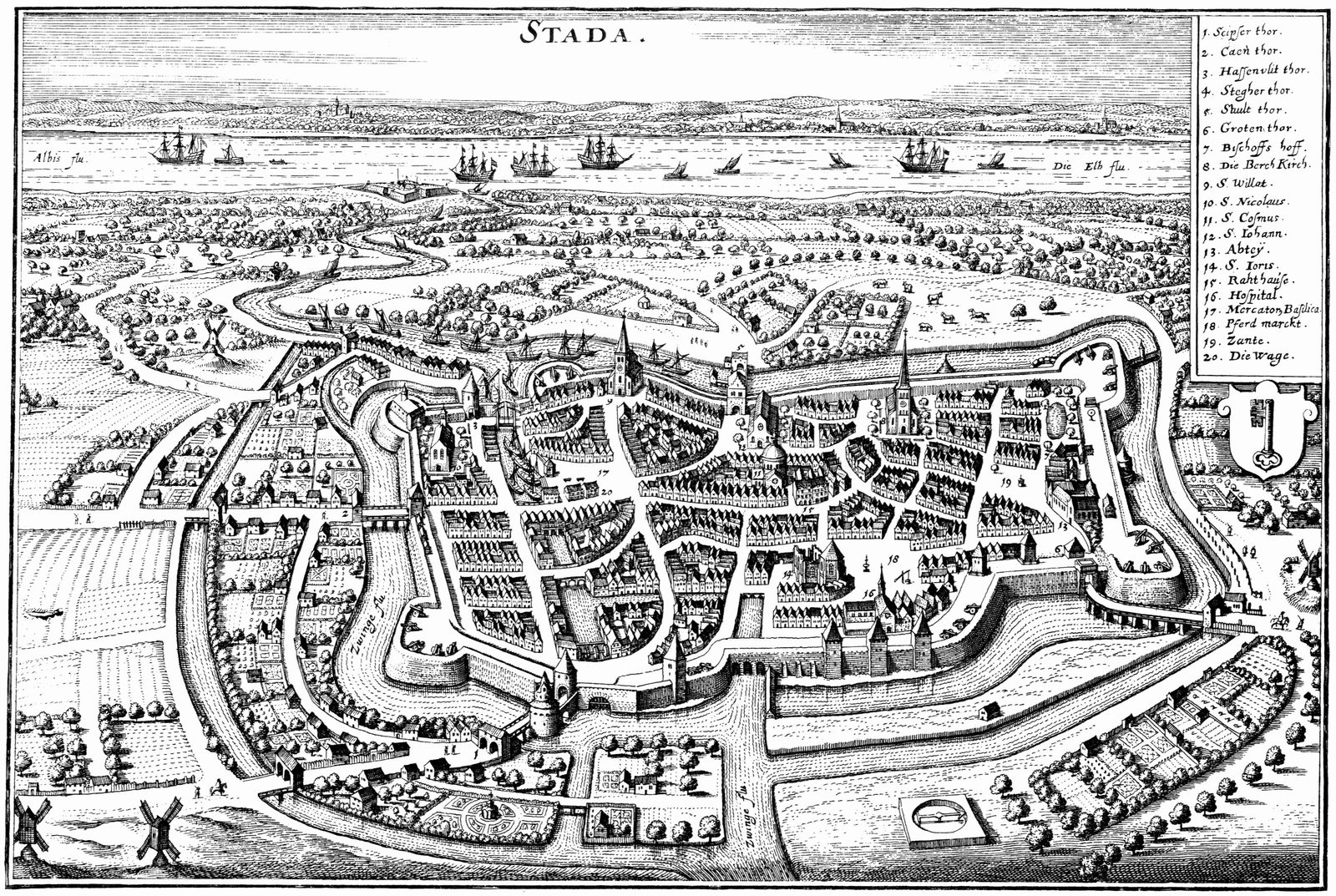
Stade um 1640, Kupferstich nach Matthäus Merian
Photo: unbekannt · Public domain
City history

A thousand years of Stade

From the settlement on the Schwinge and the first written mention in the 10th century, through the Hanseatic harbour and a century under the Swedish crown, to industry on the Elbe and the restored title of Hanseatic city. Here is the story in outline — with a timeline and the things worth knowing.

~994
first mention
1645–1712
under the Swedish crown
1659
the great town fire
2006
“Hanseatic city” again
~48.6 thousand
inhabitants today
Hanseatic city of Stade · Lower Saxony

Stade is one of the oldest towns in Lower Saxony. Its history spans more than a thousand years — from a settlement and harbour on the Schwinge, through the prosperity of the Hanse, the upheavals of the Thirty Years’ War and the century under the Swedish crown, to a Prussian administrative district and modern industry on the Elbe. Here are the main stages.

Prehistory – around 994

The earliest traces and the first mention

The area around Stade has been settled since prehistoric times — its favourable position on the Schwinge, close to where the river meets the Elbe, encouraged settlement and trade as early as the Middle Ages. An early medieval harbour and trading point stood here.

Stade appears in written sources in the 10th century — the year usually cited is around 994, in connection with a Viking raid on the surrounding area. At that time the town was the seat of the counts of Stade (the Udones); in 1144 the county passed to the archbishops of Bremen.

13th – 16th century

Hanseatic city

At the start of the 13th century Stade received town rights (confirmed around 1209). Thanks to the harbour on the Schwinge and its proximity to the Elbe, the town grew into a trading place — it belonged to the Hanse, but had to compete with nearby Hamburg for the trade routes.

From this period come the Gothic churches of St. Cosmae et Damiani and St. Wilhadi in the middle of the old town, as well as the old harbour that still survives. In the 16th century the town adopted the Reformation and became Lutheran; around 1600 English merchants — the Merchant Adventurers — even kept a base here.

1618 – 1659

The Thirty Years’ War and the great fire

The Thirty Years’ War (1618–1648) did not spare Stade — the town changed hands several times, was besieged and was burdened with levies by one army after another.

In 1659 a great fire destroyed a large part of the town. The rebuilding gave the old town a baroque character — this is when the grand merchants’ houses such as the Bürgermeister-Hintze-Haus on Wasser West were built.

1645 – 1712 / 1715

Under Swedish rule

Swedish troops occupied the town in 1645; the Peace of Westphalia (1648) awarded Sweden the former archbishopric of Bremen as the duchy of Bremen-Verden. Stade became the administrative seat of Swedish Bremen-Verden and an important fortress.

A reminder of that era is the Schwedenspeicher (1692) — a former Swedish provisions store, today the city museum. In the same period Vincent Lübeck played the famous baroque organ (Huß / Arp Schnitger) in St. Cosmae — one of the outstanding organists of his day. After a short Danish occupation (from 1712), Stade passed to Hanover in 1715.

1715 – 1866

Hanover, Napoleon, Prussia

For more than a century Stade belonged to the electorate and, from 1814, the kingdom of Hanover. During the Napoleonic period (roughly 1810–1813) the region was briefly annexed to France.

In 1866, after the Austro-Prussian War, Prussia annexed Hanover — and with it Stade. In 1885 the town became the seat of a Prussian administrative district (Regierungsbezirk Stade).

The 20th century

Railways, wars, the district

The railway connection and the growth of the administration confirmed Stade’s role as a district town. Both world wars left their mark on the region, yet the historic centre came through the Second World War largely unscathed.

After 1945 Stade lay in the British occupation zone and, from 1946, in the newly formed state of Lower Saxony. Today it is the seat of the Stade district.

From the 1970s to today

Industry on the Elbe and the Hanseatic title

Since the 1970s a large industrial area has grown up on the Elbe bank in the Bützfleth district: the Dow chemical works, an aluminium plant (today AOS — Aluminium Oxid Stade) and the Stade nuclear power station (in operation 1972–2003, now being dismantled). Later came the Airbus plant for carbon-fibre composites, which makes aircraft components.

In 2006 Stade officially regained the title of “Hanseatic city”. Today it is a town of around 48,000 people, the western terminus of Hamburg’s S5 line, the gateway to the Altes Land — Europe’s largest continuous fruit-growing region — and home to one of the best-preserved historic centres in northern Germany.

? Did you know that …

Stade — worth knowing

Vincent Lübeck The great baroque organist and composer served for almost three decades (17th century) as organist of St. Cosmae in Stade.
The Schwedenspeicher (1692) A former Swedish provisions store by the harbour — today the city museum, with exhibits ranging from the Bronze Age to the history of the town.
The Altes Land right next door The neighbouring Altes Land is the largest continuous fruit-growing area in Europe — apple and cherry trees to the horizon.
The water wheel at the Hanseatic harbour The wooden water wheel (Wasserkunst) at the old harbour — once a water pump — still turns today as a living piece of industrial heritage.
St. Cosmae & St. Wilhadi Two early Gothic churches in the middle of the old town; St. Cosmae still has its famous Huß/Schnitger baroque organ.
The end of the S5 Stade is the western end of Hamburg’s suburban railway — the quick link to the metropolis is a legacy of the 19th-century railway.
Pferdemarkt The central square of the old town — the name goes back to the medieval horse trade; today it is a place of cafés, markets and city festivals.
Ramparts & moat After the Swedish fortification works a ring of bastions surrounded the old town; the visible legacy is the green rampart ring with its moat around the historic centre.
≈ 1.5 hrs A walk through history

Historic Stade in a little over an hour

A simple walking route through the old town — from church to church, across the market square and around the old harbour. Everything within walking distance of the station.

→ See it for yourself

History you can touch

The best way to get to know Stade’s history is on the spot — in the Schwedenspeicher museum, in the Gothic churches of St. Cosmae and St. Wilhadi, on a walk around the old harbour with its wooden water wheel and baroque merchants’ houses, and out among the orchards of the Altes Land. You will find the list of places in the Sights section.

Sources & graphics. The text is our own editorial treatment based on publicly available historical material — among others on the Hanseatic city of Stade and the Stade district, plus information from the Schwedenspeicher museum — written in our own words, without copying anyone else’s text. The illustration above (the old town skyline) is our own work. Anyone wishing to add historical engravings, maps or photographs to this page should use public-domain material (for example Wikimedia Commons), Creative Commons licences or municipal collections — always with a source credit.

Help improve the portal Is a place missing, or has something changed? Tell me — I will check it and put it right.