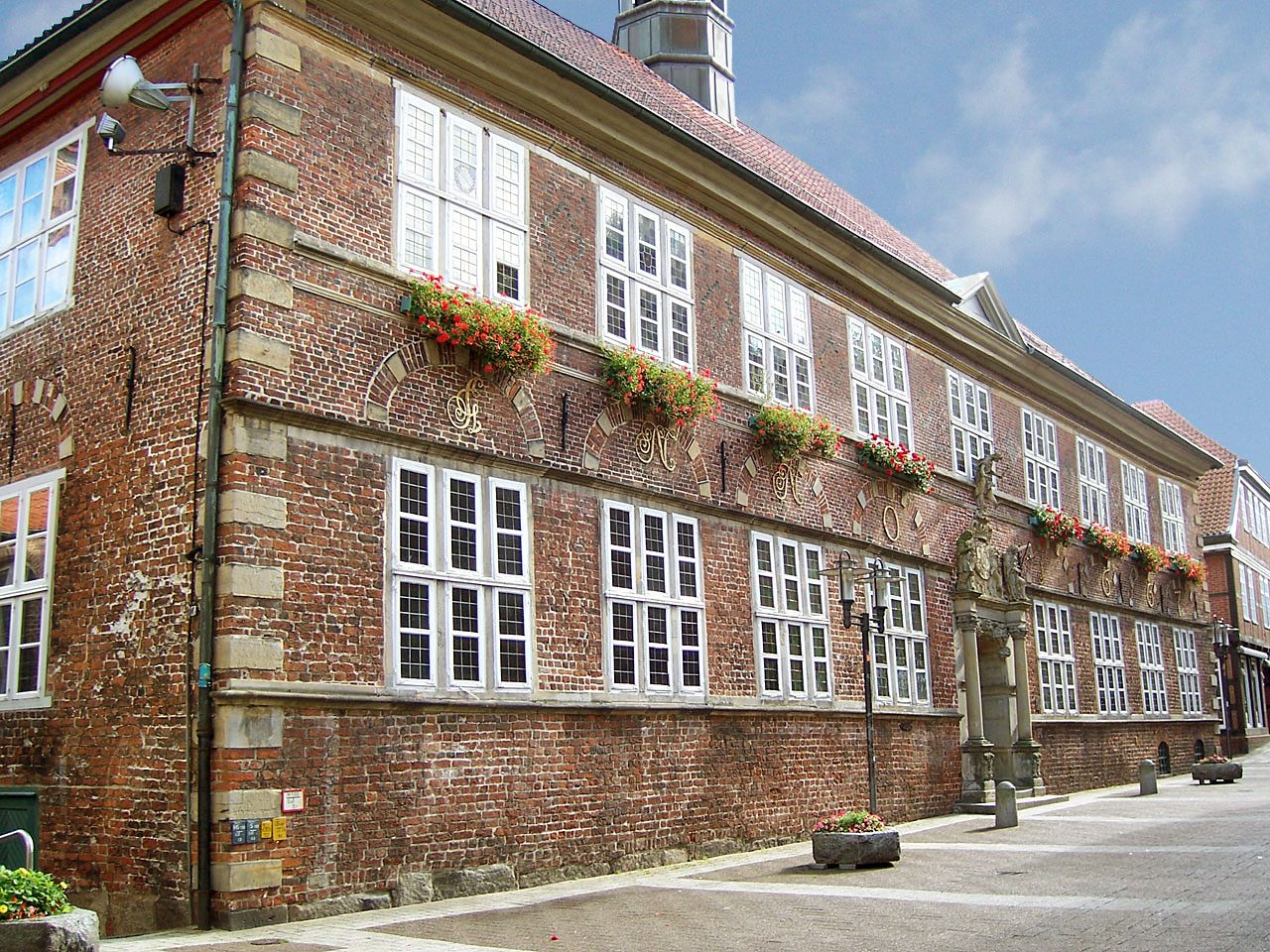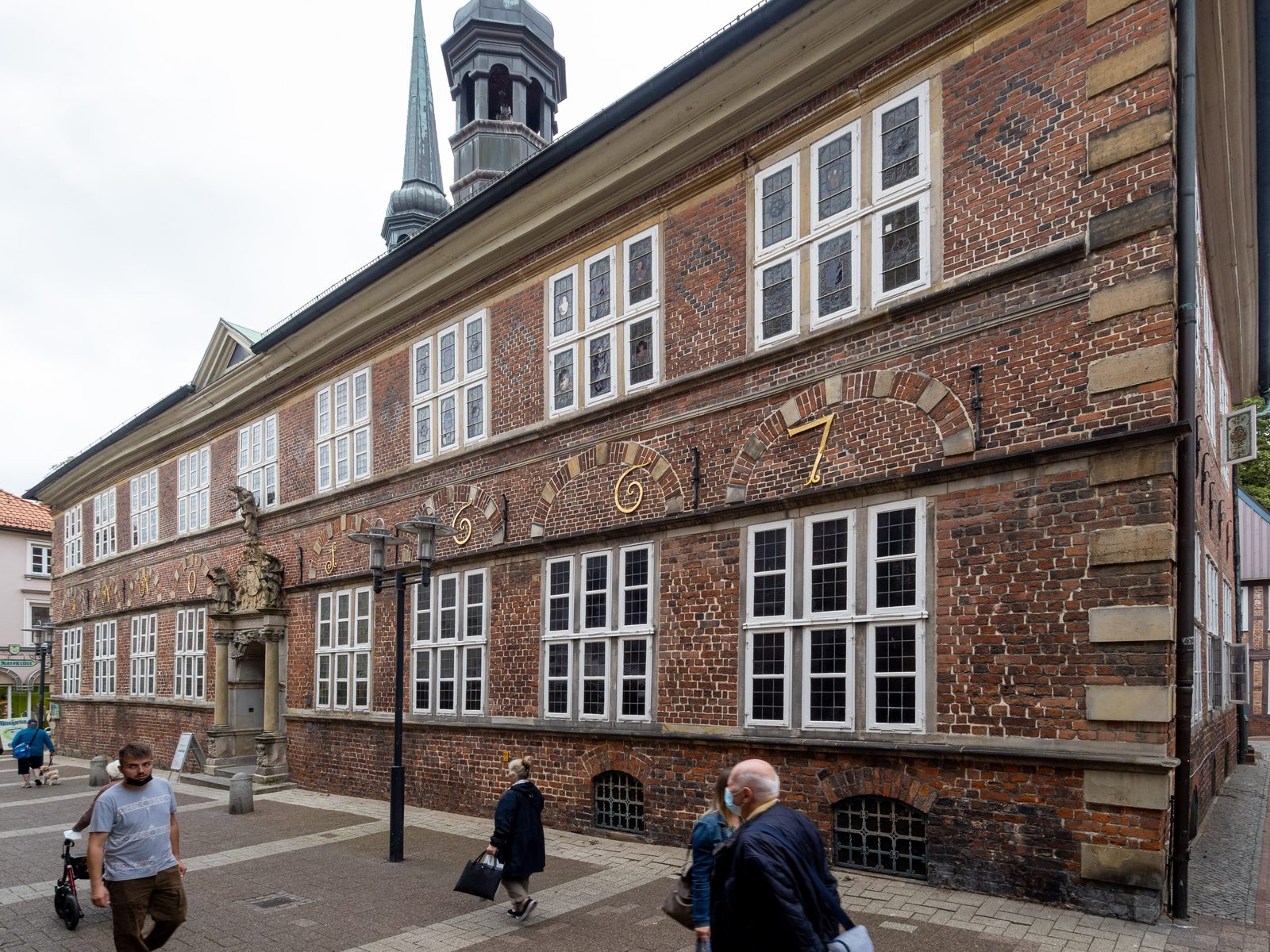
The old town hall on Hökerstraße is a building with two birthdays. One lies in the 13th century, when a town hall is first mentioned here in a document. The other is 1667, when the town set a new building on the old cellars after the greatest disaster in its history. Both layers are still visible today.
26 May 1659
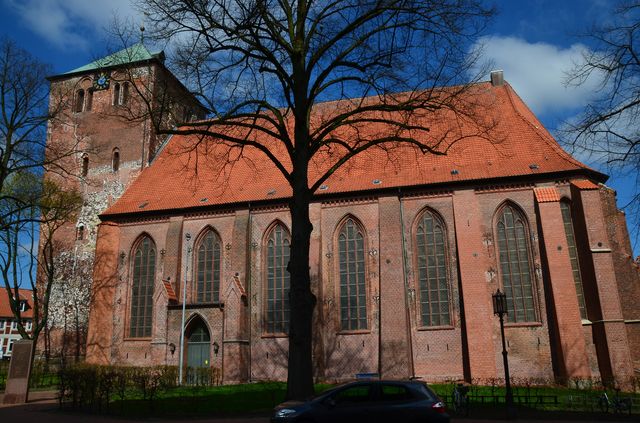
Eleven years after the end of the Thirty Years’ War, in the middle of the Swedish period, a fire broke out in Stade on 26 May 1659 that destroyed two thirds of all the buildings in the town. The two old-town churches, St. Wilhadi and St. Cosmae, survived as structures but lost their entire interiors. The town hall burnt down. Only its vaults, with the Ratskeller, came through the flames. To this day a few streets still hold houses from before the fire; most of the half-timbered houses of the old town, however, date from the decades after it, since the town was rebuilt on an unchanged street plan but with new houses.
What remained of the medieval town hall
Stade had a town hall as early as the 13th century; it is first named in a document in 1279 and was probably built shortly before. Old views show a long wing beside the church of St. Cosmae and, in front of it, two eaves-fronted houses standing across Hökerstraße with cross gables. Of that building the small vaulted cellar in the northern part of today’s house survives, along with the pillars and the two transverse arches in the large wine cellar, whose vaults were renewed in the 15th century.
It was precisely on these cellars that the new building began in 1667 — partly using the bricks of its predecessor. What arose was a two-storey L-shaped building at the corner of Hökerstraße and Cosmaekirchhof, with a hipped roof and a roof turret with an open lantern. Every structuring and decorative element is of sandstone. The long front on Hökerstraße is the main façade: cornices divide it horizontally, sandstone blocks emphasise the corners and the window arches on the ground floor, and in the middle sit the doorway and a small triangular gable.
A doorway with a message
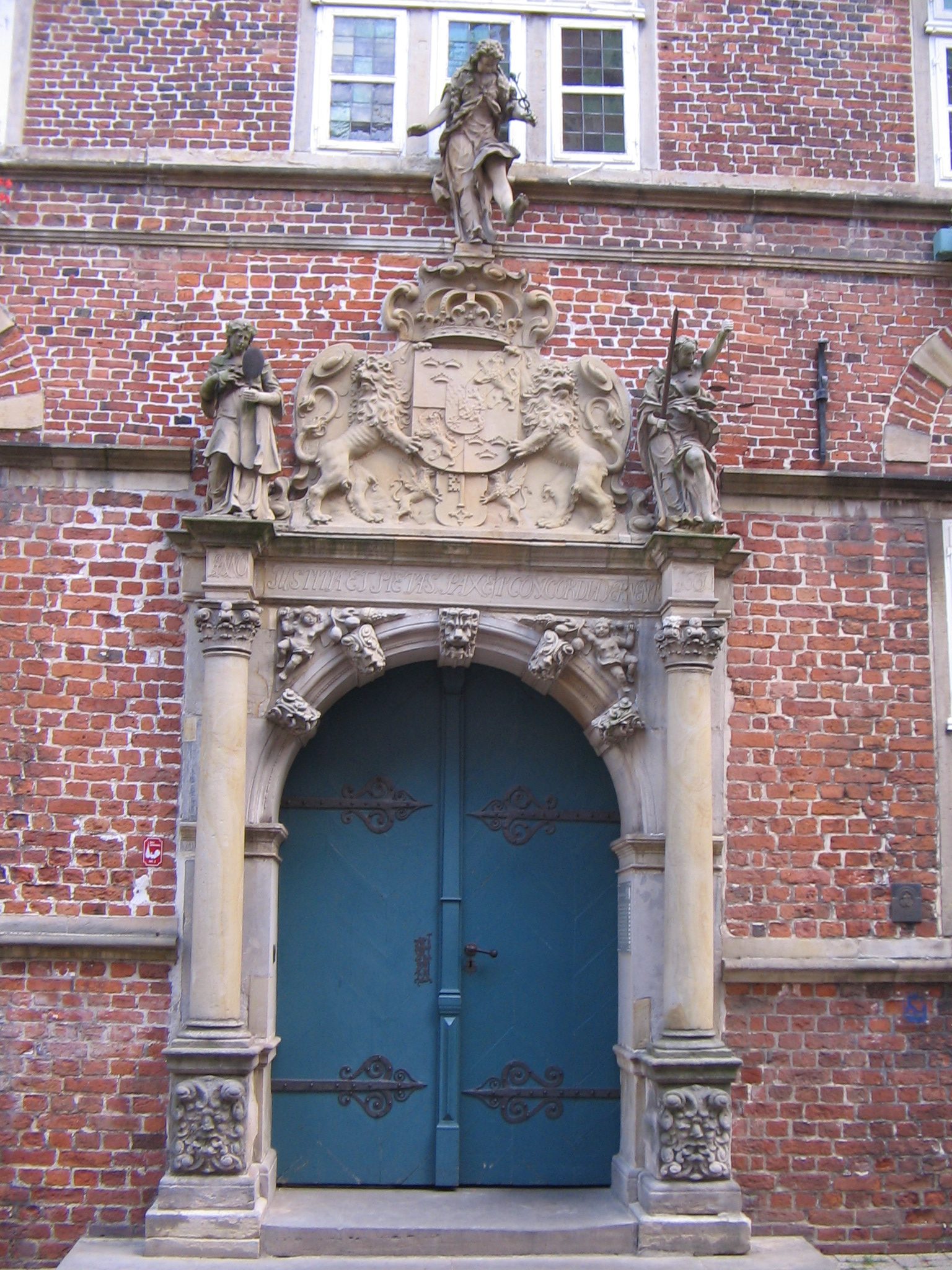
The doorway is the jewel of the house. The Bremen sculptor Wilhelm Bokeloh created it in 1667, probably following the main portal of the Bremen guild house. Two lions hold the state coat of arms of the kingdom of Sweden — a clear sign of who governed Stade at the time. At the sides stand the statues of Truth and Justice; above them sits Mercury, the god of merchants. Over it all runs the inscription “JUSTITIA ET PIETAS PAX ET CONCORDIA VERNENT”: may justice and piety, peace and concord flourish. The roof cornice and the roof turret were built to designs by Andreas Henne, the council’s master carpenter, who also left his mark inside.
Inside: staircase, doors, stucco
From the great hall on the ground floor, opposite the main doorway, a two-flight wooden staircase with heavy balusters leads upwards, also designed by Henne; in 1848 an arcade with a central basket arch was set in front of it. Henne’s doors on the ground floor have rusticated half-columns and broken triangular pediments, and are richer still on the upper floor. In 1989 they were given back their original finish according to the evidence found: red marbling below, imitation grey marble above.
The way into the great festive hall leads through an open portal with Corinthian columns and a mighty segmental pediment; on the east side of the hall the original double door with the coat of arms of the Hanseatic city and winged putti has survived. In some rooms stucco ceilings carry the date 1668 — with griffins, a pelican, Justitia and swags of fruit. Of the old furnishings an iron-bound chest and a wheeled strongbox from the 17th century survive, as do three portraits of the Hanoverian kings George I, II and III. The fittings of the former torture chamber are now in the local history museum.
The Ratskeller: wine since 1305
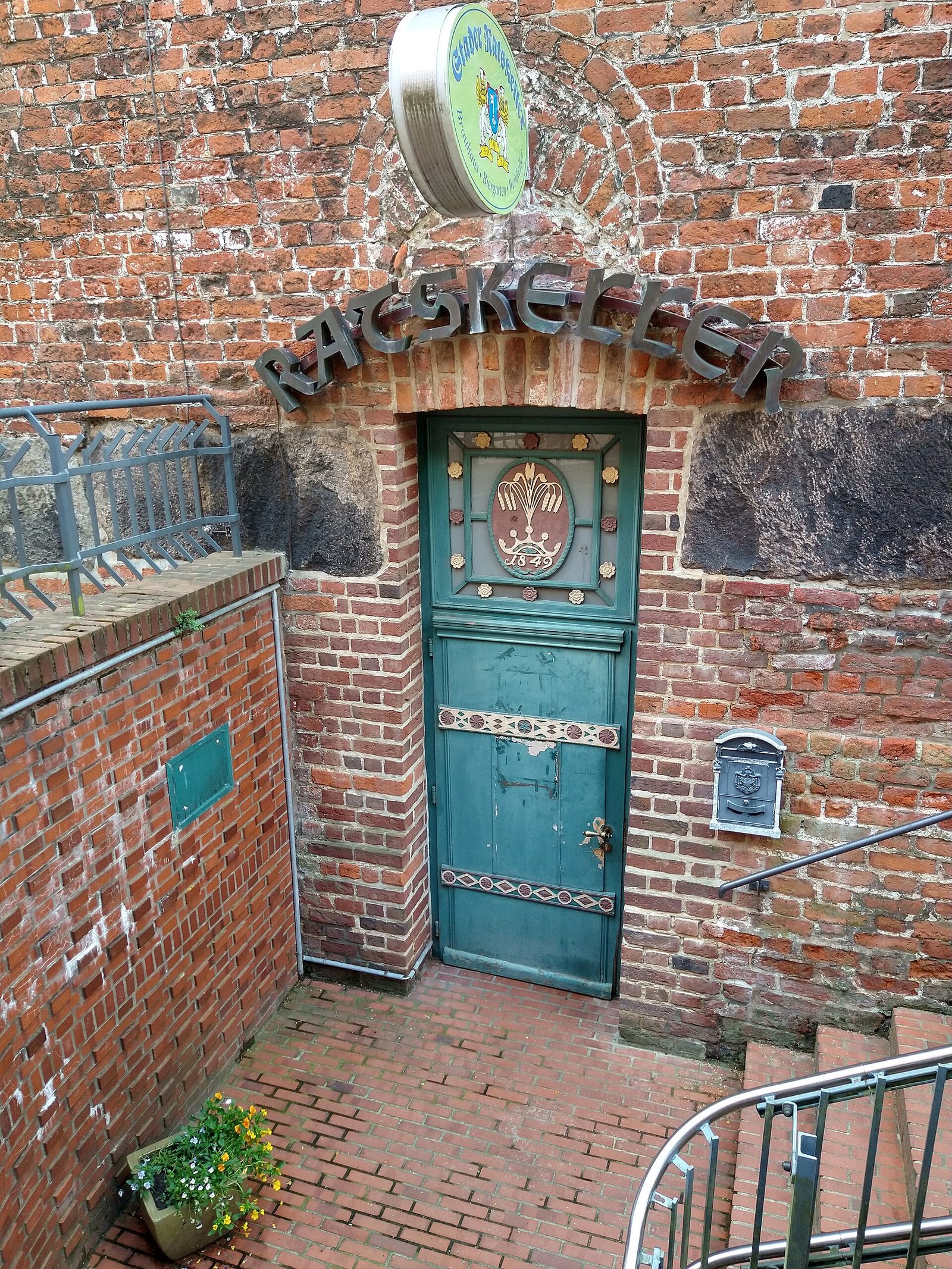
Beneath the town hall lies its oldest part. On 22 February 1305 the Ratskeller is mentioned in Stade’s first town book as a wine cellar and tavern — which makes it one of the oldest Ratskeller cellars in Germany. That it was precisely the cellars that survived the fire of 1659 preserved the building’s continuity: anyone going down there today stands in vaults older than everything above them.
The town hall today
The old town hall is used among other things for concerts and events. Its right wing adjoins the new town hall building of 1985 to 1988, which took over the administration. To the east stand the brick council warden’s house of 1844/46 and, behind it towards Hinter Hagedorn, the medieval council wine cellar house, partly half-timbered. Inside it, wall and ceiling paintings from two phases of the 17th century were discovered in 1987 — painted architecture of round arcades and medallions with lively landscapes, similar to those in the Goebenhaus on Wasser West.
Gallery