“Hansestadt Stade” appears on town signs, letterheads and buses. The addition is more recent than many suppose: only in 2009 was the town allowed to use it again, after more than 400 years. At the same time Stade bears a coat of arms documented since the 13th century, and maintains partnerships with Sweden, Israel and Poland.
What the name Stade means
The town’s name is older than any document. “Stath” in Old Saxon and “stade” in Middle Low German meant shore, coast or harbour — usually the mouth of a smaller tributary. Linguistically the word belongs with “stehen” and “stellen” and survives in the now rare German word “Gestade”. In Low German the town is still called “Stood”.
The road back to the Hanseatic title
Stade was a member of the Hanse in the Middle Ages but was expelled for good in 1601 — “de-Hansed”, as it was then put — because the town had taken in English cloth merchants. Even so, from the 1980s Stade took part in the modern Hanseatic day, a voluntary association of former Hanseatic towns.
From 2005 the town petitioned the Lower Saxon interior ministry to be allowed to bear the title officially again — explicitly for reasons of town marketing and tourism. The application was made repeatedly until it succeeded: from April 2009 Stade may again call itself a Hanseatic city “on account of its character as a seaport town”. Minister-president Christian Wulff handed over the charter on 29 April 2009, fittingly during the 800th anniversary of Stade’s town rights.
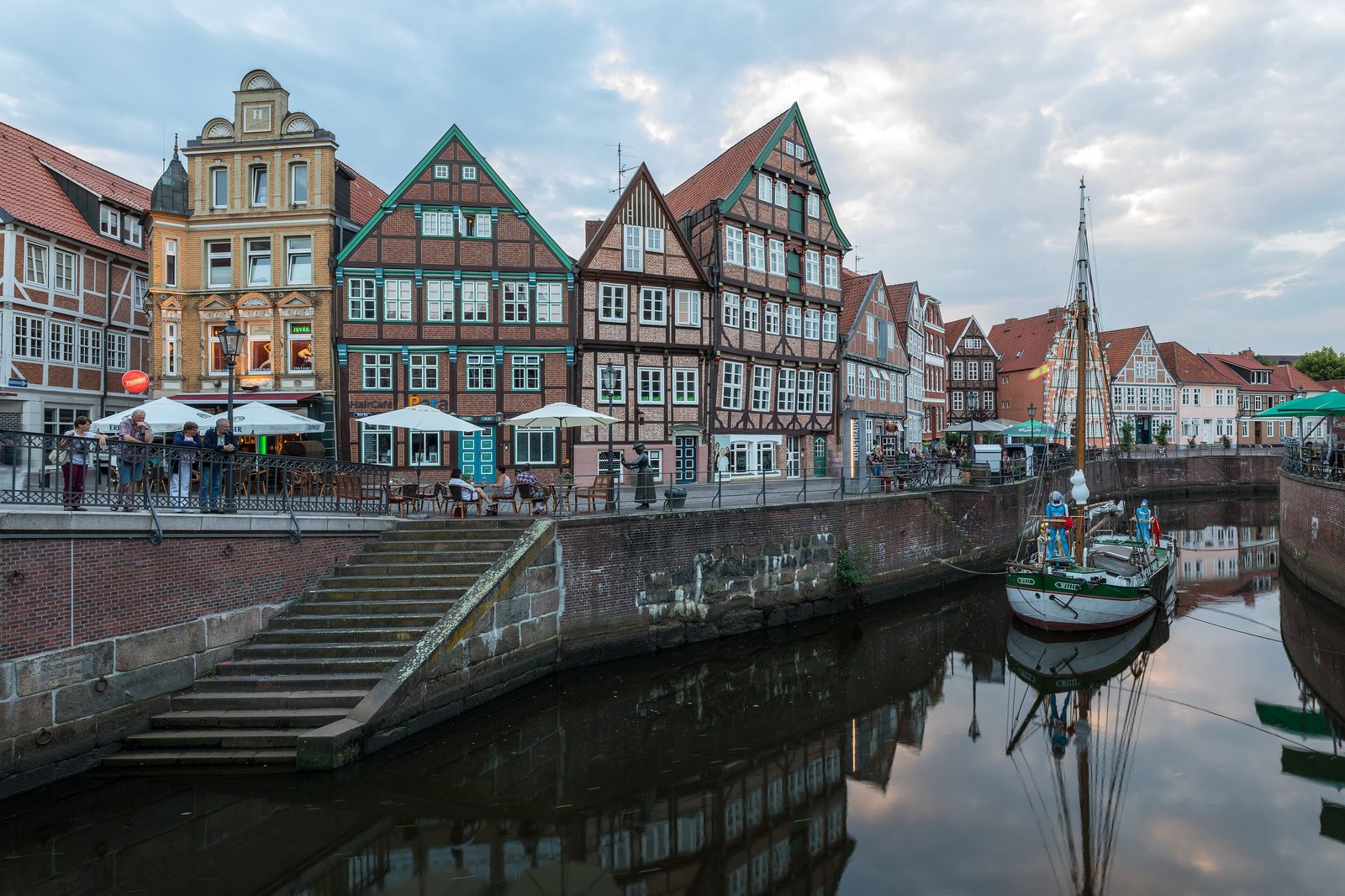
That places Stade in a longer line: until 1990 only Lübeck, Bremen and Hamburg carried the epithet officially, and since then many towns have received it anew. At least 27 German towns now use the designation as part of their name, each laid down in the municipal statutes. It is not automatic — the title applies only to towns to which it has been granted, regardless of how important they were in the historic Hanse.
Key and griffins: the coat of arms
Stade’s coat of arms shows, on a blue field, an upright silver key with its ward pointing to the right. It is the key of St Peter of the archbishops of Bremen — a reminder of the time when the town belonged to the archbishopric. On either side the shield is held by a silver griffin with a golden mane, golden wings and a red tongue. Below runs a scroll with the letters S.P.Q.ST. — “Senatus Populusque Stadensis”, the council and people of Stade, modelled on the Roman SPQR.
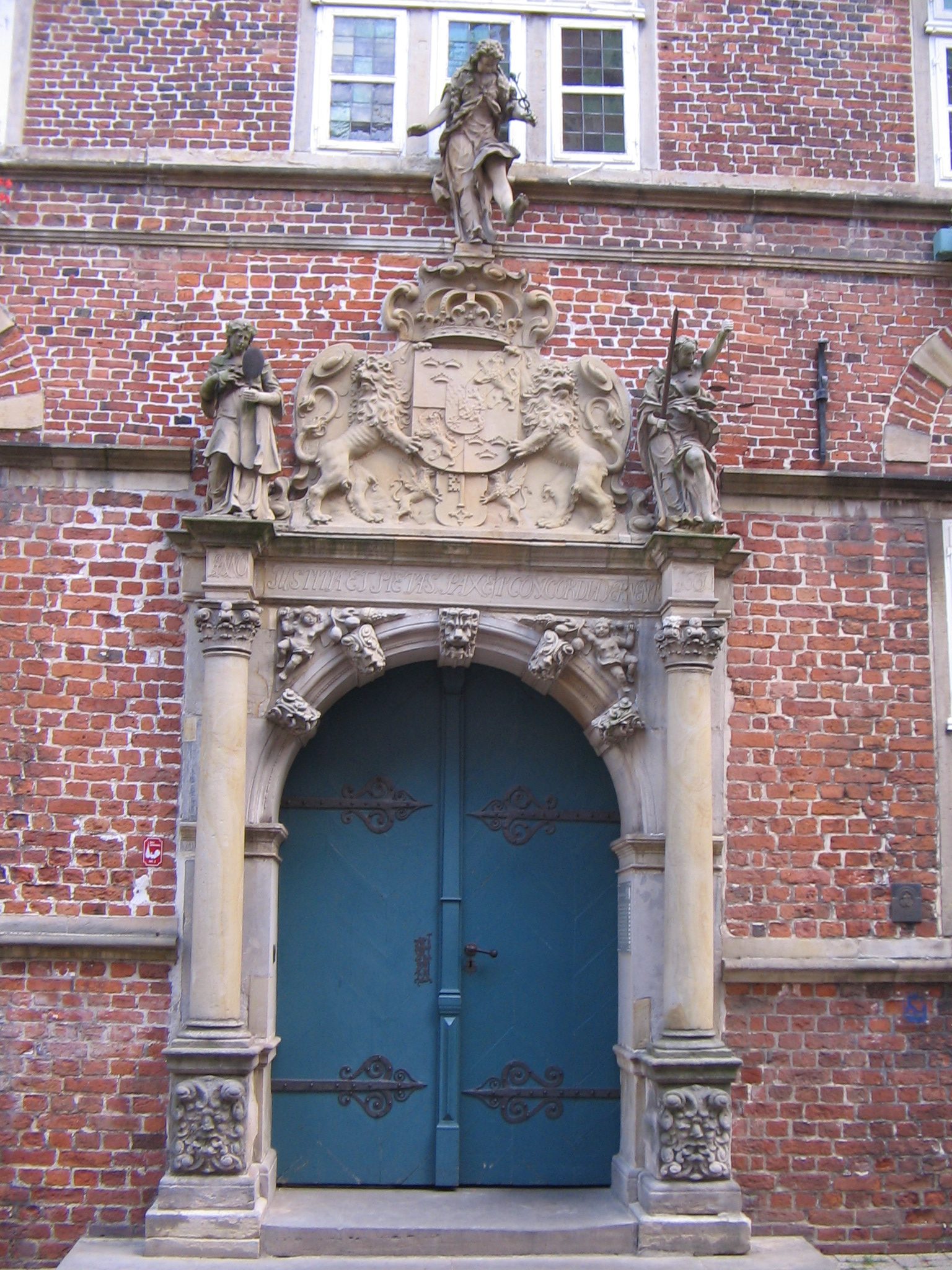
The shield with the key is attested by coin finds from the 13th century. The two griffins and the scroll were added only in the 19th century. Look closely and you will find the arms among other places on the doorway of the old town hall in Hökerstraße.
Three twin towns
The oldest surviving town twinning has linked Stade since 1983 with Karlshamn in southern Sweden — a relationship that picks up the town’s Swedish period. Since 1970 Stade has also held a “Swedish week” at irregular intervals.
On 16 July 1987 Givat Shmuel in Israel was added, a town near Tel Aviv founded in 1942 by Romanian immigrants. There is a regular youth exchange with it. The third partner, since 24 March 1998, is Gołdap in north-eastern Poland, in former East Prussia near the border with the Kaliningrad region. There is a youth exchange with Gołdap too, supplemented by an exchange between different occupational groups in turn — a connection that, for the many Poles living in Stade, hardly anyone notices in daily life.
The four brotherhoods
Among Stade’s peculiarities, finally, are four historic brotherhoods that still exist. Three of them arose in the late Middle Ages as prayer communities: the St Pankratii brotherhood of 1414, the St Antonii brotherhood of 1439 and the Rosary and Divine Aid brotherhood of 1482. The youngest, the merchants’ and skippers’ brotherhood, was founded in 1556 as an association of ferrymen and grain traders; in the 17th century its members collected money to ransom seafarers from Turkish captivity.
All four see themselves as communities of mutual care and support people who have fallen into hardship through no fault of their own. In the 18th century they stagnated; in the second half of the 19th they flourished — and they remain active in social welfare and cultural support to this day.