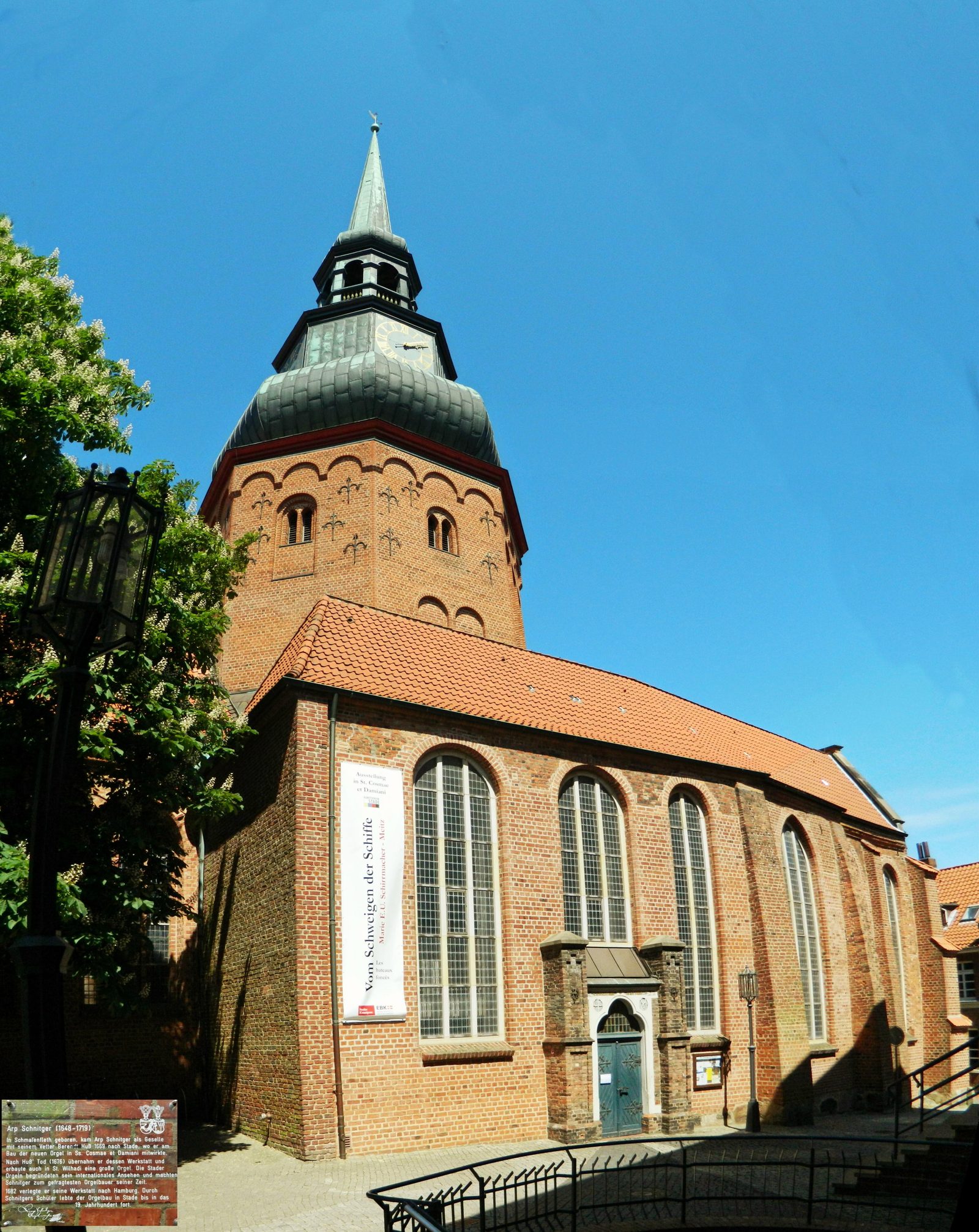
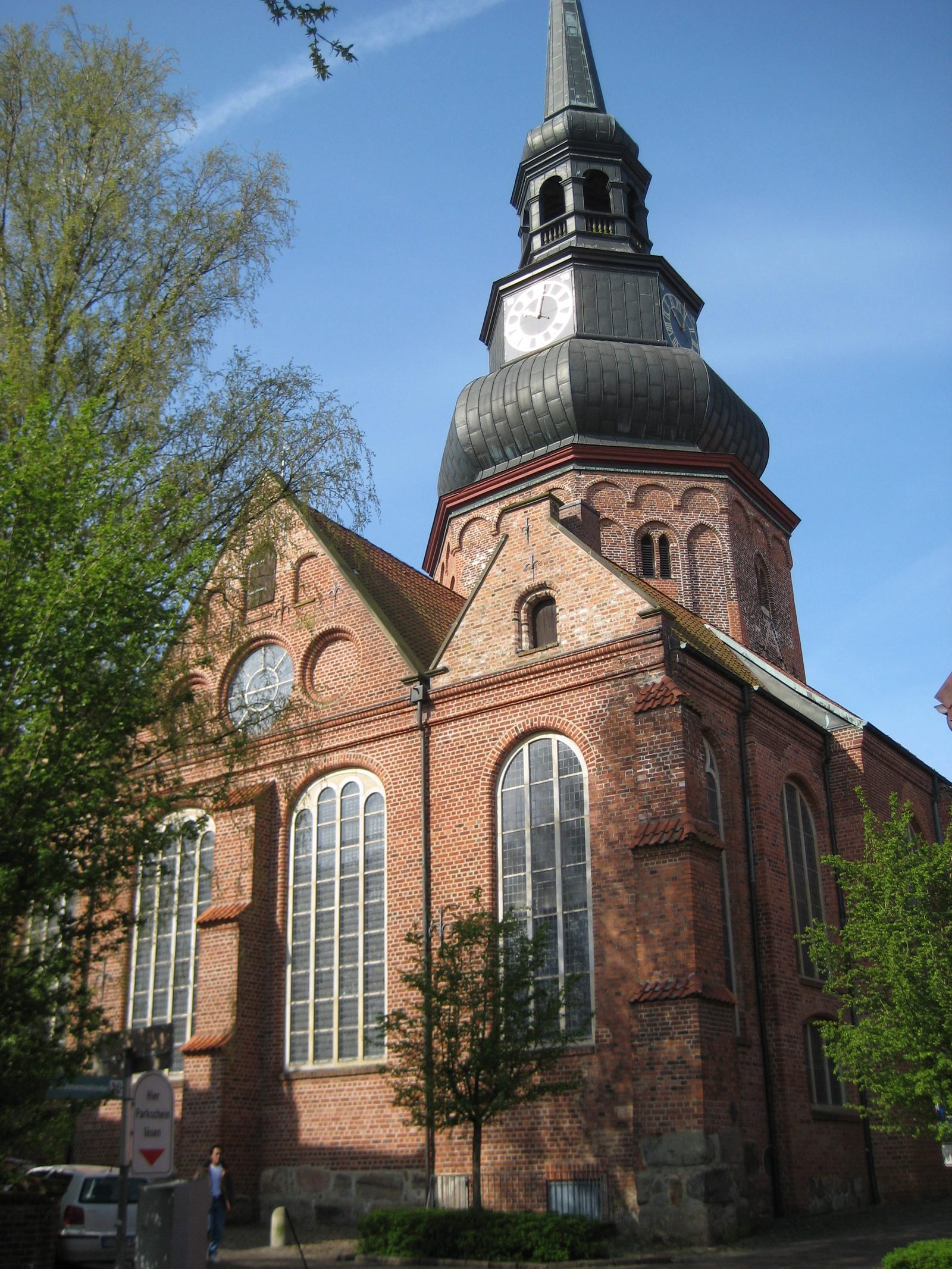
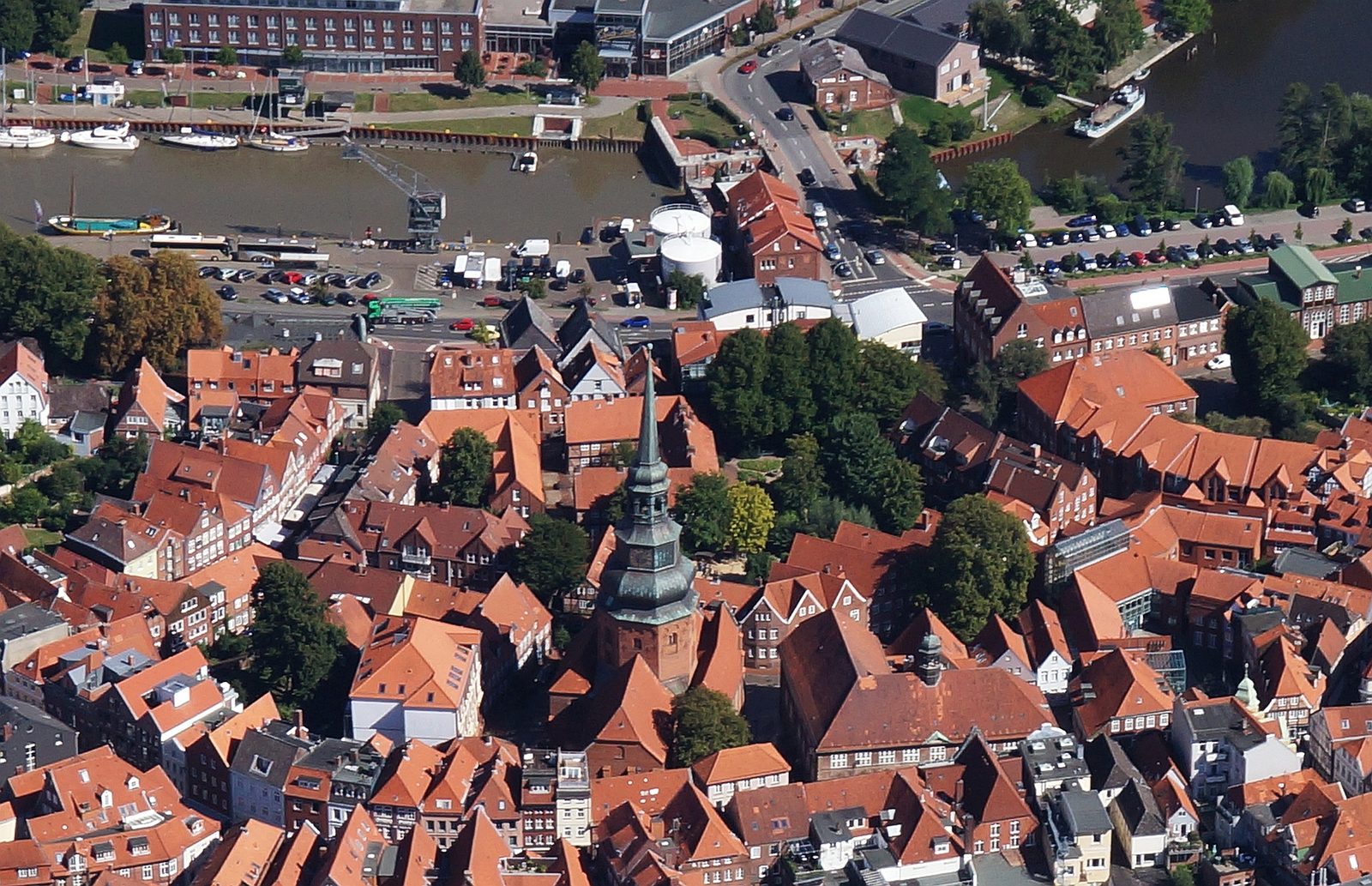
Approach Stade and it is the first thing you see: the octagonal, curving spire of St. Cosmae et Damiani, a good 62 metres high, rising above the roofs of the old town. The church of the holy physicians Cosmas and Damian is the principal church of the Stade church district — and for music lovers all over Europe a place of pilgrimage, for it holds one of the earliest organs Arp Schnitger worked on.
From a counts’ chapel to a town church
The beginnings lie in the 12th century: in the 1130s a chapel of the counts of Stade is mentioned, subject to the archbishop of Bremen. Nothing of that building can be made out from outside today, but the dedication probably dates from then — Bremen cathedral owned important relics of the two Syrian physician saints and could pass some on. Strictly speaking the church is called Ss. Cosmae et Damiani because it has two patrons; the people of Stade usually just say “the Cosmae church”.
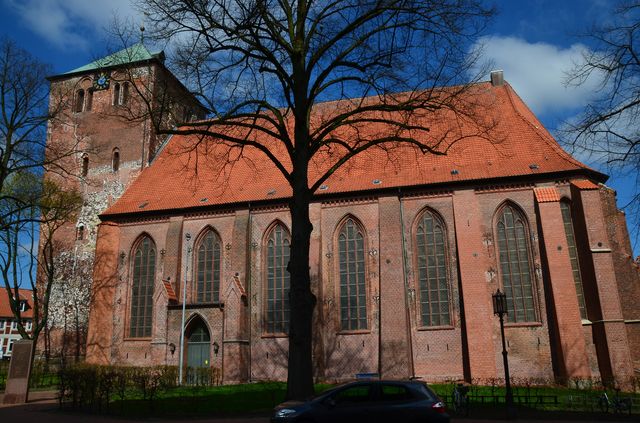
Today’s brick building on a cruciform plan is the result of several building phases from the 13th to the 17th century. The oldest parts are in the nave, the transepts and the vaulted crossing. In the 15th century a three-aisled chancel replaced the original east end. There was a crossing tower as early as around 1550: on Martin Weigel’s view of the town it can be recognised by its openwork, onion-shaped dome.
The fire of 1659 and the new spire
The great town fire of May 1659 hit St. Cosmae hard as well: the spire, the roof structures and the entire interior were lost. Restoration took a quarter of a century. In 1684 the octagonal baroque dome was set in place, and it has shaped the townscape ever since. Without the weather vane the tower measures 62.45 metres.
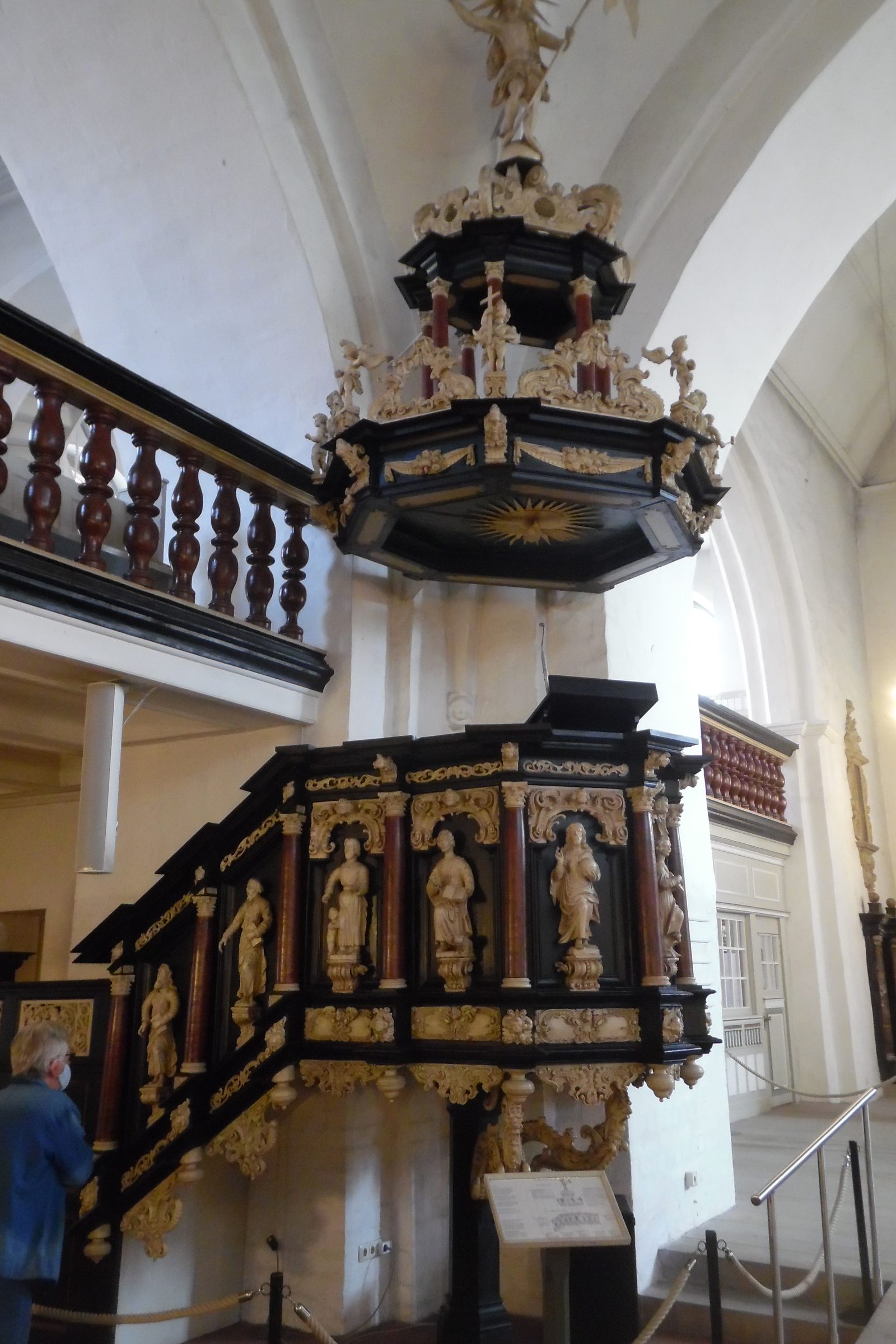
Almost everything that makes the interior so impressive today comes from the years after the fire. Hermann Benningk of Hamburg recast the bells in 1663; the pulpit was made the same year and is decorated with figures and lavish cartilage ornament. The marble font of 1665 rests on alabaster figures of the four evangelists. The pews in the north transept, from around 1730, were reserved for the magistrate.
The organ by Huß and Schnitger
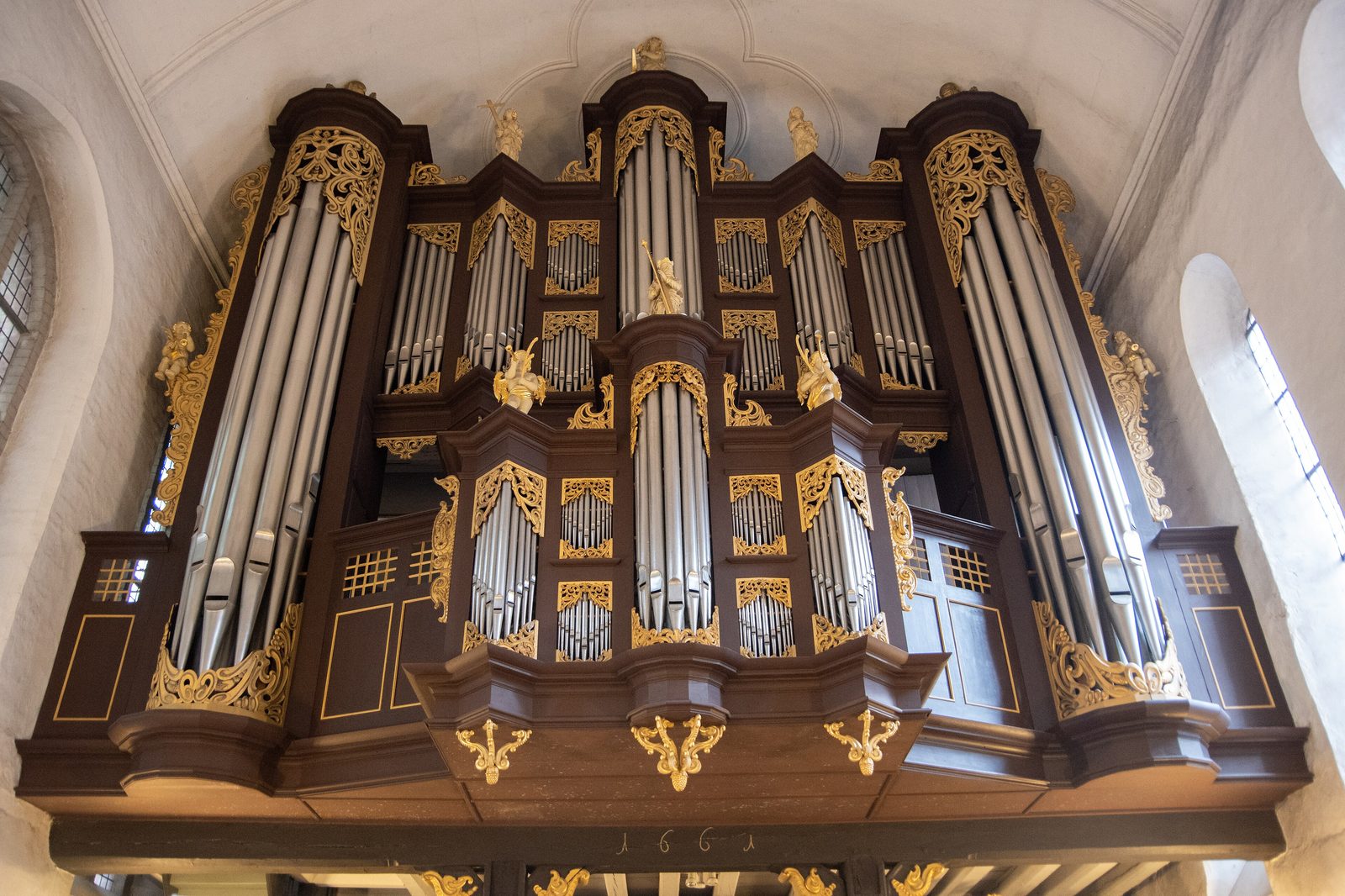
Between 1668 and 1673 the Glückstadt organ builder Berendt Huß, together with his nephew and journeyman Arp Schnitger, built the great organ of St. Cosmae. For Schnitger, then in his mid-twenties, completing the Stade instrument in 1673 crowned his years of apprenticeship — later he would become the foremost organ builder of the north German baroque, with workshops in Stade, Hamburg, Bremen and Groningen and some fifty pupils. After his master’s death Schnitger first carried on the Stade workshop for Huß’s widow and worked as an independent master in the town from 1677 to 1682, before moving to Hamburg.
In 1688 Schnitger replaced four of his master’s stops with new ones. Others intervened later — Otto Diedrich Richborn in 1727/28, and from 1781 further rebuilds that cut into the original substance. Between 1972 and 1975 the instrument was elaborately reconstructed with the help of the organ advisory committee of the Hanoverian regional church. Today it counts among the great surviving baroque organs of northern Germany.
Vincent Lübeck at the Cosmae organ
The organ had scarcely been finished when it acquired an organist of rank: in 1674 Vincent Lübeck, then barely twenty, took up his post at St. Cosmae and married Susanne Becker in the same year. He stayed in Stade for almost three decades and earned a reputation as organist, composer and teacher. He and Arp Schnitger were friends for life. In 1702 Lübeck moved to St. Nicolai in Hamburg, where Schnitger’s largest organ was at his disposal. His work — preludes, fugues, cantatas — belongs to the north German organ school and stands stylistically close to that of Dieterich Buxtehude; the young Johann Sebastian Bach heard him play in Hamburg. Stade later named a grammar school after him.
The altar by Christian Precht
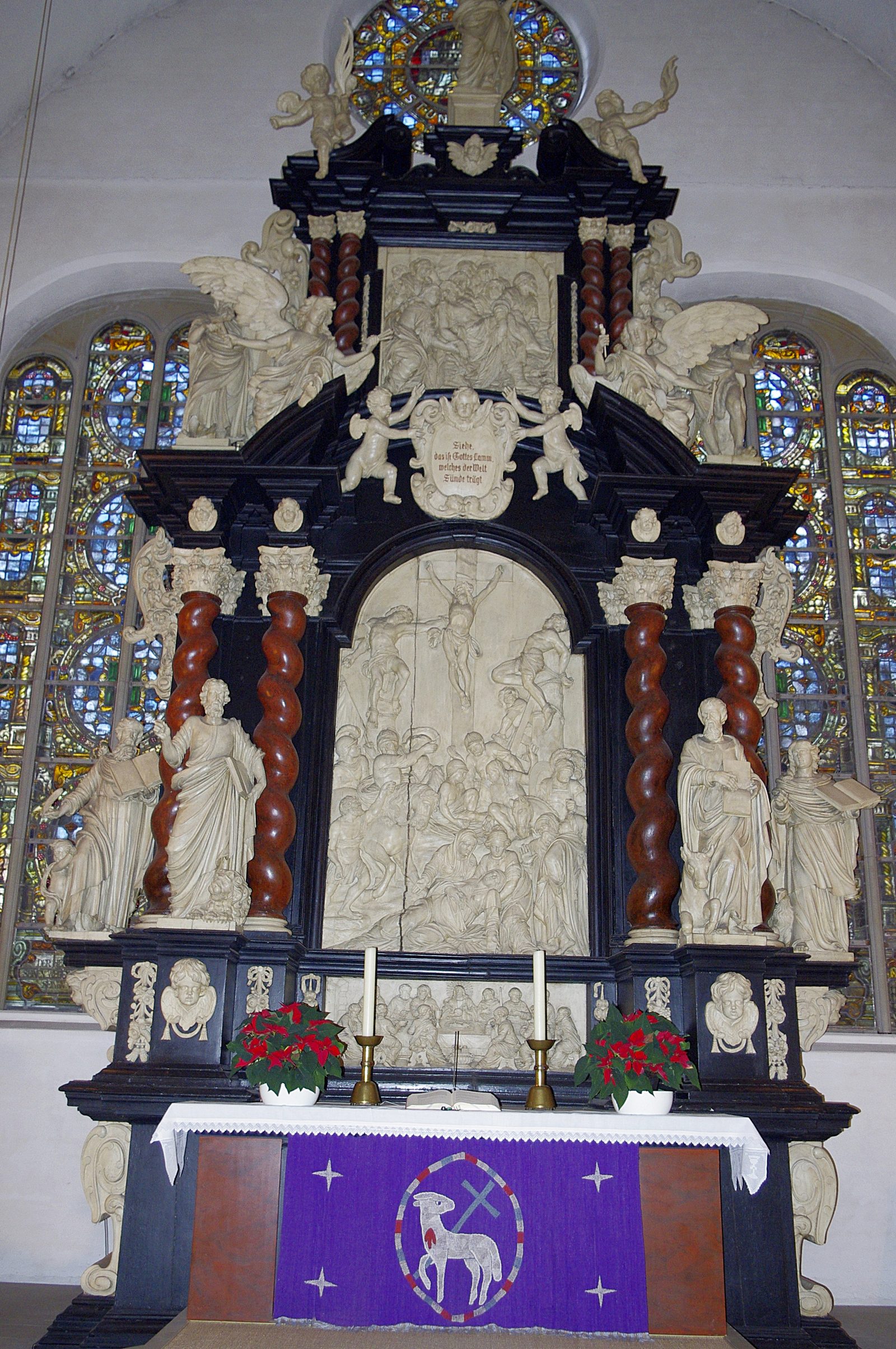
The eye-catcher of the chancel is the baroque high altar, created by the Hamburg sculptor Christian Precht between 1674 and 1677. The predella holds a relief of the Last Supper, the central panel shows a crowded Crucifixion group with the four evangelists, above it a relief of the Entombment; the whole is crowned by the risen Christ. The white finish of the carved wooden figures imitates marble or alabaster.
Considerably older is the winged altar of about 1500, which originally stood in the long-demolished Gertrude chapel outside the Schiffertor. At its centre stands the holy abbess Gertrude with a model of her chapel; on the badly damaged outer wings, scenes from her legend are painted — including, as befits a Hanseatic town, a cog. The coloured windows behind the high altar date from 1910.
Ten bells in the tower
The peal consists of ten bronze bells. It came through the First World War intact; in the Second the second-largest bell had to be handed over to be melted down. It was replaced in 1959 — a gift from the Hamburg shipowner Ernst Jung and his wife Claere, who also had a five-note cymbal peal cast. These small, high bells bear the names of musical instruments and ring the Easter motif “Resurrexi”. In the tower lantern hang two clock bells of 1669 and 1683 as well.
Together with St. Wilhadi and St. Nicolai in Bützfleth, St. Cosmae forms the Protestant Lutheran town parish of Stade. If you would like to see both old-town churches in one afternoon: they are only a few minutes’ walk apart — addresses under Sights.
Gallery
Sources
- Wikipedia: St. Cosmae et Damiani (Stade) (03/2025)
- Wikipedia: Arp Schnitger (08/2026)
- Wikipedia: Vincent Lübeck (07/2026)