At the start of the 13th century the burghers of Stade turned the quarrel between the Welfs and the archbishops of Bremen to their own advantage — and won a law of their own. Within a few decades the town had a town hall, a harbour basin and a constitution. It joined the Hanse early, only to lose its membership in the end because of English cloth merchants.
An emperor, an archbishop and a privilege
After the fall of Henry the Lion, Stade was disputed for decades between the archbishopric of Bremen and the Welfs. The town stood, so to speak, between two masters — and that is precisely what gave it room to manoeuvre. In 1209 Emperor Otto IV, himself a Welf, granted Stade its town rights. When the county finally returned to the church of Bremen after settlements and treaties, the archbishopric confirmed that law in 1236 and subsequently granted the town two valuable concessions: staple rights, which obliged passing merchants to offer their goods for sale in Stade, and exemption from military service, that is from the duty to provide the ruler with soldiers.
A manuscript of the Stade town law was drawn up in 1279; it is still kept in the town archive. In the same year the council gave itself a constitution of its own, the Stade statutes. They laid down that the council was elected once a year — although only the councillors themselves were entitled to vote. This was no civic democracy, but it was a measure of self-government that strengthened the town against count and bishop alike.
Five quarters, five churches
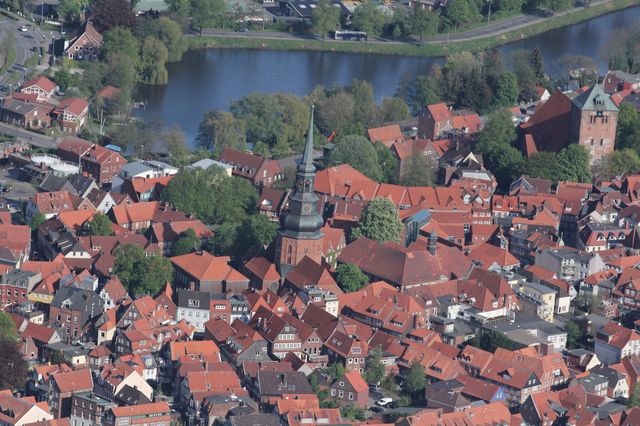
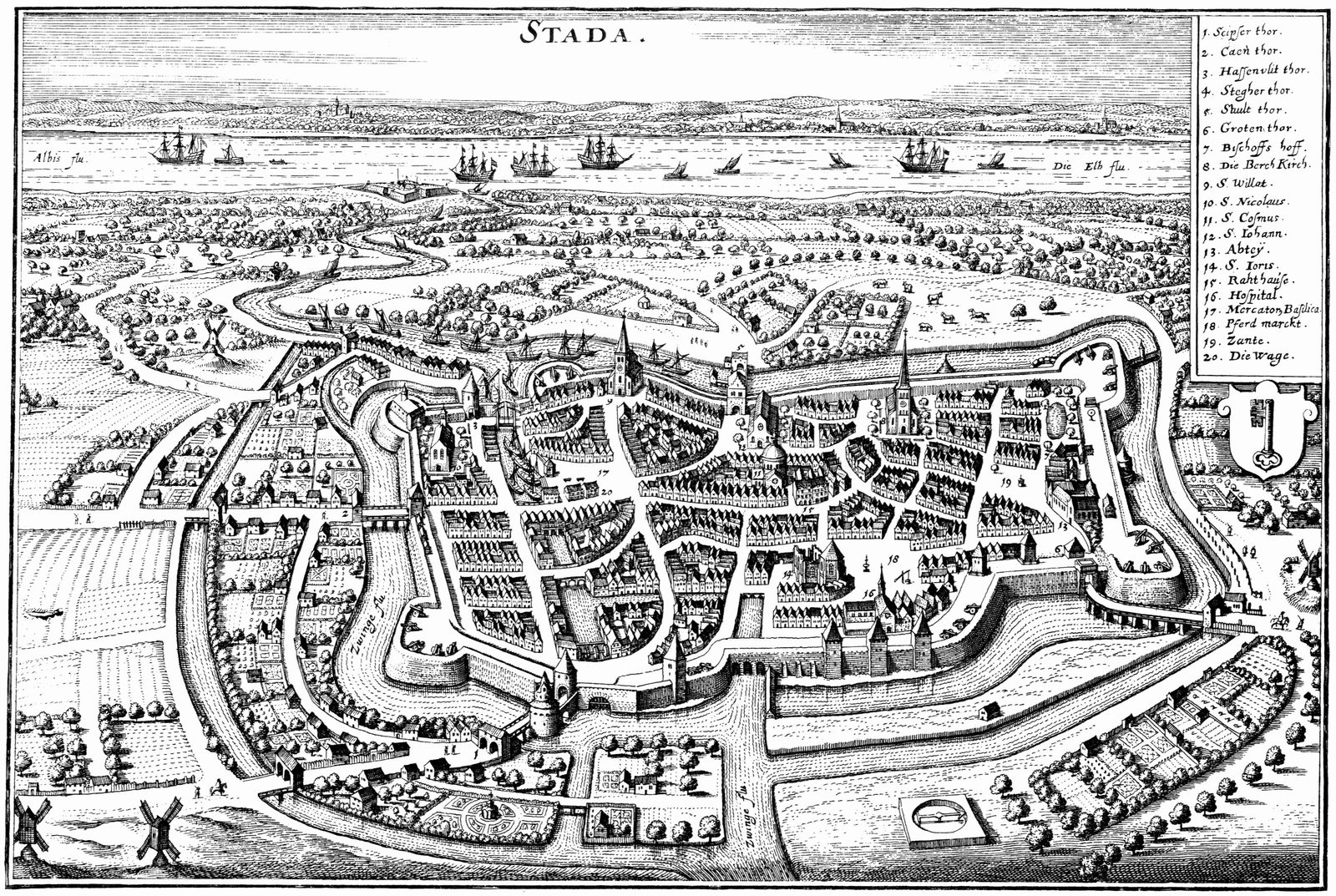
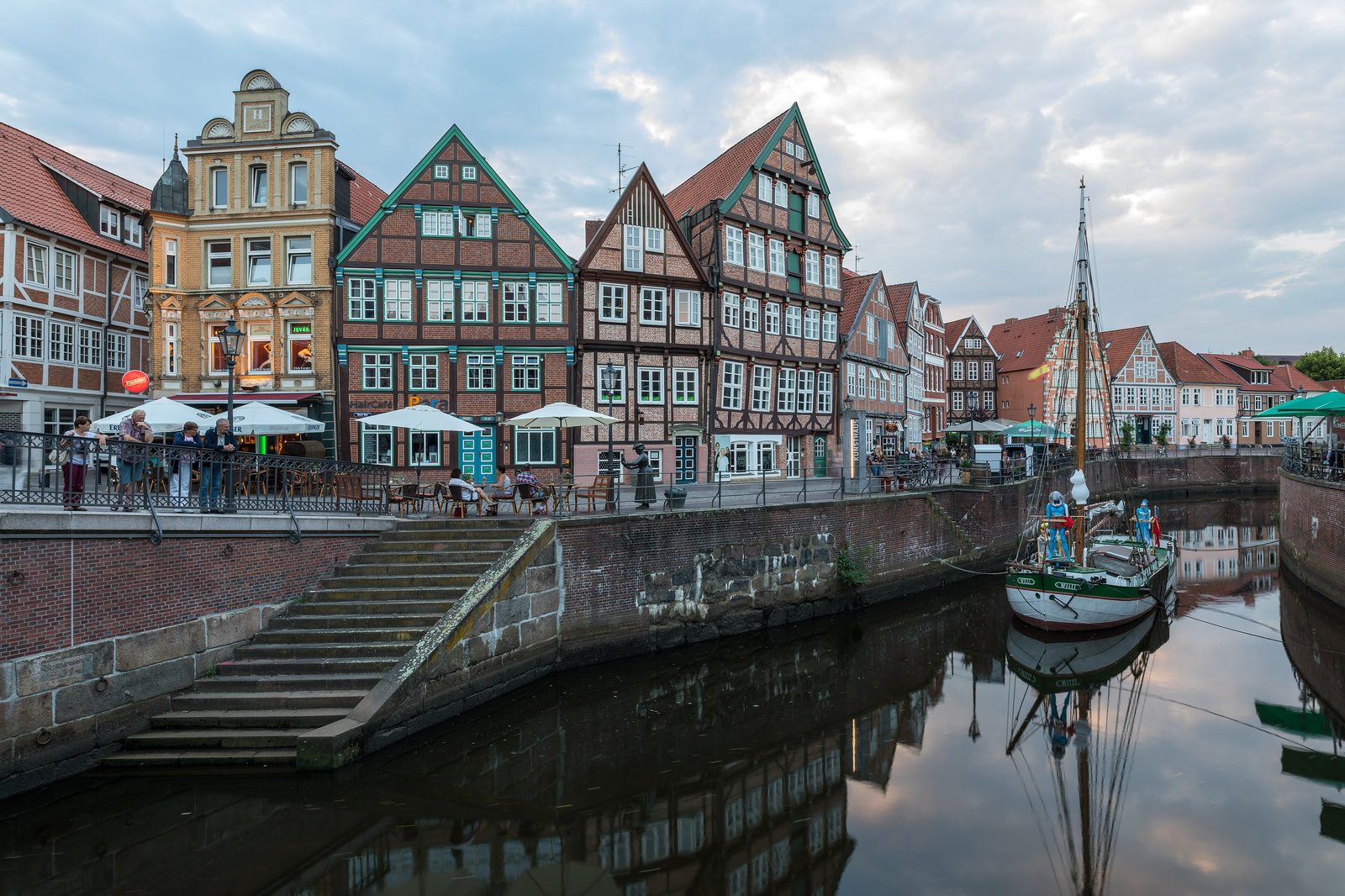
Medieval Stade consisted of five quarters, and each had its own church. Around today’s Pferdemarkt lay the monastery quarter around the priory of St. Georg. Adjoining it, along what is now Hökerstraße, was the merchants’ quarter with the church of Ss. Cosmae et Damiani. Around St. Wilhadi lay the quarter of the bishop of Bremen. In the northern old town the fishermen lived by St. Nicolai, and finally there was the counts’ castle quarter with St. Pankratii.
Of those five churches only two still stand: St. Cosmae and St. Wilhadi. The names of the quarters, however, live on in streets and squares. Anyone walking today from the Pferdemarkt through Hökerstraße down to the harbour is walking through the monastery and merchants’ quarters of the 13th century.
The town grows into the water
Space was short on the geest spur. The people of Stade therefore raised the marsh ground and enlarged the town area by more than a third. There was already a town hall in the 13th century; today’s Altes Rathaus goes back to a building first mentioned in a document in 1279 and probably put up shortly before. Around 1300 the harbour was given a larger basin with quay walls along the sides — almost exactly the shape the old Hanseatic harbour still has. So that ships could reach it, the Schwinge was deepened several times from the 15th century onwards.
Social care found a home early too: a leper house is documented from 1307, out of which the Gertrudenstift grew in 1319. Its building fell victim only in 1712, to the Danish siege. From 1361 the town held, for a time, the right to conclude alliances of its own — a remarkable degree of independence for a town under episcopal rule.
In the Hanse
The Hanse was not a state but an association of merchants, mainly north German, which from the mid-12th to the mid-17th century looked after safe trade routes and common interests abroad. At its height almost 300 seaports and inland towns belonged to it; the cog became its symbol. Stade was a member from early on and from 1373 sent representatives to the Hanseatic diets, the assemblies of the towns.
The harbour on the Schwinge was the economic heart of that period. But nearby Hamburg grew faster, and competition for the trade routes on the Elbe was a constant theme. Reformation and urban development ran side by side: carried above all by the monks of the priory of St. Georg, Stade turned Protestant; Johann Hollmann preached the first Lutheran sermon as early as 1522.
Expulsion — because of English cloth merchants
The end of membership came through a commercial decision that looked shrewd at first sight. In 1587 Stade admitted the English cloth merchants of the Merchant Adventurers, a trading company the Hanse regarded as a rival. The response was severe: in 1601 Stade was “de-Hansed” for the second time and now for good, that is expelled from the league. The English did not stay long — in 1611 they moved their base to Hamburg. Stade had lost the Hanse and the English with it.
There was a postscript only four centuries later. Since the 1980s the town has taken part in the modern Hanseatic day, a voluntary association of former Hanseatic towns. And since April 2009 — right on time for the 800th anniversary of its town rights — Stade has once again been officially allowed to call itself a Hanseatic city. The charter was handed over by the then prime minister of Lower Saxony on 29 April 2009.
Sources
- Wikipedia: Stade (Abschnitt Mittelalter und Hansezeit) (08/2026)
- Wikipedia: Grafschaft Stade (07/2026)
- Wikipedia: Altes Rathaus (Stade) (01/2025)
- Wikipedia: Hanse (08/2026)
- Wikipedia: Hansestadt (08/2026)